Showing posts with label books. Show all posts

Wednesday, September 6, 2023

The School of Life by Alain De Botton - A Book Review

The School of Life is a beautiful book written by Alain De Botton with wonderful insights on each page. The book has five sections Self, Others, Relationships, Work, and Culture. Sharing a few of the snippets from the book here.

The School of Life by Alain De Botton


Alain maps many of our life habits and reactions to our childhood upbringing. He says, “Children can’t go anywhere. They have no extended social network. Even when things are going right, childhood is a gentle open prison.” A volatile parent may be the reason for our current meekness. A continually busy, inattentive parent was the catalyst for someone to be an exhausting attention seeker.

The markers of emotional health are self-love, candour, and communication. A few signs of self-love are not pleasing others indiscriminately and being willing to leave an abusive union. Candour is the ability to accept negative feedback about ourselves because valuable lessons come in painful guises. Communication is not to think that others can read our minds and thoughts. One needs to know how to formulate one’s complaints into a convincing, perhaps humorously framed point that has a chance of winning over its target.

Alain beautifully talks about fame and its invariable negative impacts in four pages. He says, “One wants to be famous out of a desire for kindness. But the world isn’t generally kind to the famous for long. This is because the celebrity of a few people will always contrast painfully with the obscurity of the many. So, soon enough the world will comment negatively on their appearance, it will pore over their setbacks, it will judge their relationships, and it will mock their new ventures. The assessments will flood in from people who will express from the safety of the newspaper office or screen.”

As a cure, Alain says that appreciation and understanding are only available through individuals one knows and cares about, not via groups of thousands or millions of strangers. There is no shortcut to friendship – which is what the famous person is in effect seeking. A famous person can market and advocate for their products in public but ignore the good and bad comments of strangers in the wider world.

In a debate between materialism and virtue, he talks about The Fable of the Bees written by Bernard Mandeville. In the book, Bernard mentions that shopping for pleasure and vanities helped the economy to grow. It was the consumption of Mandeville called “fripperies” – hats, bonnets, gloves, butter dishes, soup tureens, shoehorns, and hair clips – that provided the engine for national prosperity and made a genuine difference to the lives of the weak and the poor.

Alain talks about the 12 ingredients of wisdom. In that, he says the following about Regret. In our ambitious age, it is common to begin with dreams of being able to pull off an unblemished life, where one can hope to get the major decisions, in love and work, right. But the wise realize that it is impossible to fashion a spotless life. We will make some extremely large and utterly uncorrectable errors in a number of areas. Perfectionism is a wicked illusion. Regret is unavoidable. The errors in life are not coincidental but structural.

The book has 295 pages. Apart from the book, the YouTube channel by the same name, The School of Life, @theschooloflifetv has wonderful videos. The videos have so many animations and graphics and are well presented. I have been handing out copies of School of Life book to my family and friends and I’m sure you will too once you read the book. Go for it! 

Saturday, June 3, 2023

Interview with Read 'n' Rejoice Library Founder Sasikala

Sasikala started the Read ‘n’ Rejoice library on 19th Feb 2016. Let us hear about her entrepreneurial journey of establishing and running a library and how she overcomes challenges. 


When did you decide that you wanted to start a lending library?

I couldn’t find a suitable job after a career break of 4 years. So, I contemplated the idea of a startup. But I was firm that it should be helpful to society. As books were my passion, I decided to start a library and a Kids’ Activity Club.

What are the different steps you took to start the library?

We did a survey of our apartment residents to check their interest level. I spoke to a couple of other libraries to understand the feasibility. After I decided to start the Read ‘n’ Rejoice library, I found a suitable location in Medavakkam. I got the Ministry of Micro, Small, and Medium Enterprises (MSME) registration done. I procured books from different sources. Then we did website development and hosting, marketing, and more. 

We now have 1400+ members registered with the library and around 430 active members.  We have 9500 books. We cover the books with lamination sheets and our staff are trained to clean and arrange them properly at regular intervals.


What was the first set of books you bought for the library? What are the fast-moving books now in English and Tamil?

The first set of books we bought were Enid Blyton’s Famous Five and Secret Seven series followed by Kalki novels. Geronimo Stilton, Percy Jackson, and Wimpy Kid are fast-moving children’s books. In Tamil, Kalki, Balakumaran, and Sandilyan novels are fast-moving.

How did your reading habit help you in making the library flourish?

Many members who join the library have no idea about books. They need suggestions that suits their interest. As I read books from different genres, I am able to guide them. I also send regular book suggestions to members, and conduct books clubs that help them to choose the books.

What are the advantages of being a member of Read ‘n’ Rejoice library?

Read ‘n’ Rejoice members get regular updates on the latest books that are added to the library and book suggestions. Books are delivered to their home if they opt for it. They can participate in the activities and contests conducted by us.  

We conduct phonics, cursive writing, and robotics classes at the library. We also conduct story sessions, science workshops, book clubs, public speaking, storytelling and quiz contests.


What are the hurdles you face from online memberships?

The main hurdle is getting delivery boys, who keep changing. The next challenge is that at least 25% of the overall librarian’s effort is spent on packing the books, preparing the list for delivery, and arranging the returned books. It involves cost and effort.

What inputs do you get from the readers and how do you change your work or purchase based on those?

We get book suggestions from members. We read the Goodreads website reviews for the suggested books. Then we check the availability. If the books are available at a reasonable price, we procure them immediately.


How does your family help in running the library?

My husband helps me in website updates and books procurement. My mother-in-law takes care of the family when I am busy with library activities.


What are other challenges you face in running the library and how do you overcome them?

As there's floating population in Medavakkam, members are moving out quite often. The number of adult readers is less. So, whenever children are busy with academic activities, members don't continue with the library. I keep suggesting books for adults through messages and motivate them to read. This is because family reading is best to create interest for children to read.


What criteria you plan to follow for selecting franchise partners for Read ‘n’ Rejoice?

Location should be within 10 kms from our current library location. He/She should have interest in books. 

Read 'n' Rejoice website: https://readnrejoice.in/

Instagram Handle: ReadnRejoice

Sasikala - Founder of Read 'n' Rejoice Library

We wish Sasikala outstanding success with her library Read 'n' Rejoice and her noble thought of spreading knowledge through books. 

Thursday, March 2, 2023

Read 'n' Rejoice Library - 7th Anniversary Celebrations

Read ‘n’ Rejoice library in Medavakkam celebrated its 7th Annual Day on 19th Feb in the library. The library was started by Sasikala. Sasikala worked in IT for approx 10 years. After that, she had to take a break of 3 years and went with her family to England. When she came back to Chennai, Sasikala was unable to get a new IT job as she had a break. She did not want to sit idle at home. So, she started the Read ‘n’ Rejoice library. The library has 3 compact rooms, but it houses 10,000 books for both kids and adults in English and Tamil on a wide range of subjects.


Books ranging from Vedic Maths to Picture Books

Song

The Annual Day started with a song by Sasikala’s daughter Sahana and her friend. Then Chief Guest Anitha (myself) spoke about the benefits of reading and libraries. She spoke about how reading stories and fiction improves our empathy and emotional intelligence. And that the same neurons that fire when you do an action fire when you read about that action.

Here is the video of the Speech: 

Then Anitha conducted a storytelling session ‘Everyone is Unique’ with songs and actions. The kids danced. Then prizes were given to enthusiastic library members. Sasikala spoke about the library. Few parents shared their experience of shaping the reading habits of their kids and themselves.

Here is the video of the Storytelling: 


Sasikala Speaks


Parents Speech

Read ‘n’ Rejoice also sends books online to kids in nearby areas. They also plan to open a franchise within 10 kilometers soon.  

Visit Read ‘n’ Rejoice website here: https://readnrejoice.in/

 Read 'n' Rejoice Instagram: @readnrejoice         

Sasikala and Anitha


Kid-Friendly Walls 

Gift from Read 'n' Rejoice
                                                                      

Sunday, December 4, 2022

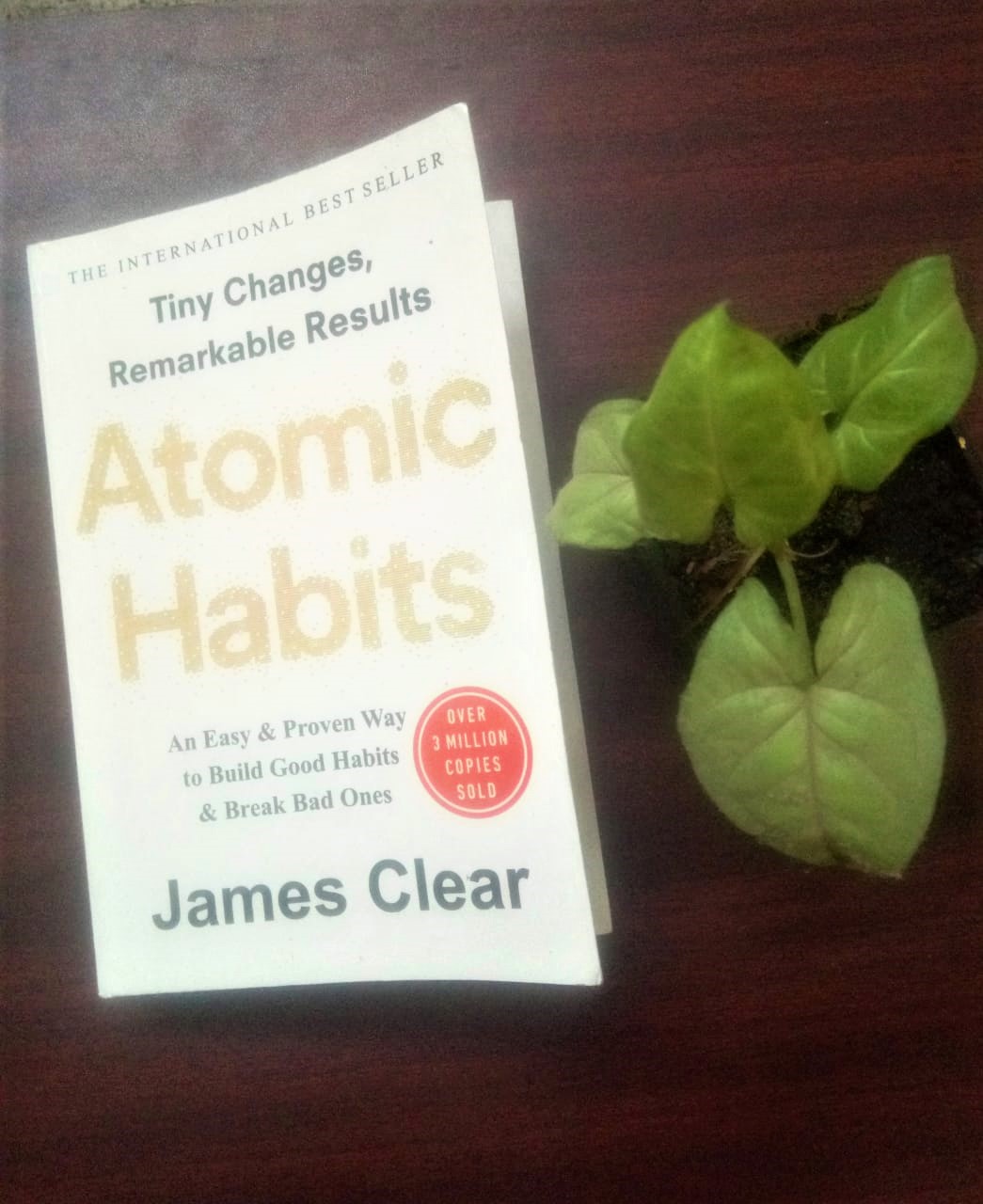
Atomic Habits by James Clear - A Book Review

Read the book Atomic Habits by James Clear. Here are some interesting nuggets from the book. James recommends identity-based habits instead of outcome-based habits. So, if you want to reduce weight, you can say you want to get rid of 4 kilos (outcome-based). Or you can say that “I am a healthy person” (identity-based). Once you decide that you are a healthy person, you inculcate all habits of a healthy person like exercising regularly, eating right, and monitoring your weight. So, you have to decide who you wish to become and follow processes that help you achieve that identity. The ultimate form of intrinsic motivation is when a habit becomes part of your identity. Decide the type of person you wish to be. Prove it to yourself with small wins. 


However, James warns that there is a valley of disappointment whenever we start practicing a new good habit. The positive outcomes are not immediate. He draws upon the analogy of an ice cube that sits on a table and you are watching it melt. The temperature of the room rises bit by bit from twenty-six degrees to thirty-one degrees. The ice does not melt, and you may be disappointed. But, when the temperature reaches thirty-two degrees, the ice suddenly begins to melt. Similarly, the good results of small, atomic habits take time to manifest.


James outlines four simple steps that lead to habit formation – 1. Cue, 2. Craving, 3. Response, 4. Reward. Cue and craving make up the problem phase. Response and reward make up the solution phase. For example, Problem Phase is: You hit a stumbling block on a project at work (cue); You feel stuck and want to relieve your frustration (craving). The Solution phase is: You pull out your phone and check social media (response); You satisfy your craving to feel relieved (reward). Checking social media becomes associated with feeling stalled at work. Before a habit forms, the happiness chemical dopamine is released at the reward stage. But once a habit is formed, dopamine is released immediately after the cue is recognized.

To create a good habit, James asks us to make it obvious; make it attractive; make it easy; make it satisfying. He suggests a lot of techniques and tools to achieve this. First, he asks us to write down our Habit Scorecard. It will be the list of all major activities you perform from dawn to dusk. This gives you an idea of what habits you would like to continue, and what habits you would like to get rid of. When I wrote my Habit Scorecard, I became conscious of bad habits like biting my nails, scrolling social media, and eating sweets.

Sample Habit Scorecard

He asks us to write an implementation intention. I will [Behavior] at [Time] in [Location]. Implementation intention for exercise: I will exercise for one hour at 5 p.m. in my local gym. Every habit is context-dependent. So, we have to redesign our environment and reduce cues that tempt us. We imitate the habits of those who are close to us, habits followed by many people, and habits of the powerful. One of the most effective things you can do to build better habits is to join a culture where your desired behavior is the normal behavior.

Habits are formed based on the frequency and not time. A commitment device is a choice you make in the present that controls your future. For example, Victor Hugo was falling back on his book writing deadline as he was pursuing other projects and entertaining guests. So, when the publisher set a revised deadline, Hugo locked all his clothes in a closet. He wore only a large shawl. As a result, he could not go out or meet guests. So, he wrote furiously and completed his book The Hunchback of Notre Dame on time.

Dopamine Spike - A. Before Habit Formation, B. After Habit Formation

A weightlifting coach told James about what made outstanding champions. He said, “At some point, it comes down to who can handle the boredom of training every day, doing the same lifts over, and over, and over.” The ability to fall in love with the boredom of doing a task repeatedly ranked higher than genetics, luck, or talent.

James covers other interesting topics like habit stacking, the Goldilocks rule, habit contract, accountability partner, habit tracking, and many more. He gives a lot of insightful examples.

I usually underline or mark a book for important points while reading. In this book, I wanted to underline almost every line as every point was interesting and important. The book has 271 pages of main content and is one of the best books I have read so far. Go for it! 

You can download the Habits Cheat Sheet at : https://jamesclear.com/atomic-habits/cheatsheet 

Visit https://jamesclear.com/ for more insights.  

Saturday, October 8, 2022

Deep Work by Cal Newport - A Book Review

I read the book “Deep Work” by Cal Newport. The entire book speaks about doing deep work with full focus and concentration without getting distracted. Deep Work is valuable, rare, and meaningful. It revolves around the philosophy of, “I’ll live the focused life, because it’s the best kind there is,” by Winifred Gallagher.


The definitions for Deep Work and Shallow Work in the book are as follows.

Deep Work: Professional activities performed in a state of distraction-free concentration that push your cognitive capabilities to their limit. These efforts create new value, improve your skill, and are hard to replicate.

Shallow Work: Noncognitively demanding, logistical-style tasks, often performed while distracted. These efforts tend to not create much new value in the world and are easy to replicate.

An example of deep work is a cardiac surgeon who performs a complex heart surgery for 2 hours. The surgeon can’t afford to get distracted as it is a question of life and death. An example of shallow work is sending funny forwarded videos on Whatsapp.

Cal offers a quick trick to determine if the work you are doing is deep or shallow. Ask yourself, “How long would it take (in months) to train a smart recent college graduate with no specialized training in my field to complete the task (that I want to do)?”

He states 2 examples for the above question. To properly edit an academic paper requires immense knowledge of the subject and you need fifty to seventy-five months to train a recent graduate. On the other hand, to create a Powerpoint presentation that describes your quarterly sales, you will need only two months to train the recent graduate. Cal tells that we can evaluate each task we are about to do on a shallow-to-deep scale like this.

Cal’s rules for deep work are Work Deeply, Embrace Boredom, Quit Social Media, and Drain the Shallows. Cal speaks about the different philosophies of deep work scheduling – monastic, bimodal, rhythmic, and journalistic based on the time and frequency of your core task and other tasks. He talks about a grand gesture where you, for example, book an expensive hotel in an inspiring place to finish your deep work. Your investment shows how important the task is for you and so you focus better. When we do deep work, we complete the work fastly. This reduces the need to work late nights and on weekends.

Image Courtesy VerbalToVisual.com


The best aspect of the book is that Cal at no point claims his method or idea is the best and only way. He is quick to offer counter-examples of people succeeding without doing much deep work.  

I liked a well-written passage in the book on Unconscious Thought Theory (UTT) and would like to quote the same. Some decisions are better left to your unconscious mind to untangle. In other words, to actively try to work through these decisions will lead to a worse outcome than loading up the relevant information and then moving on to do something else while letting the subconscious layers of your mind mull things over. If you need to do a math calculation, only your conscious mind is able to follow the precise arithmetic rules needed for correctness. On the other hand, for decisions that involve large amounts of information and multiple vague, and perhaps even conflicting constraints, your unconscious mind is well suited to tackle the issue.

Cal Newport

The book has many examples, opinions, counter-examples, and techniques to do deep work and avoid distractions. The book has 296 pages of which the core content is 263 pages. You can know more about Cals’ work from his blog named Study Hacks at https://www.calnewport.com/blog/ 

Wednesday, July 13, 2022

Moonshot by Albert Bourla – Story of making Pfizer Vaccine for Covid-19 – A Book Review

In the book Moonshot, Dr. Albert Bourla, CEO of Pfizer, narrates the rollercoaster journey in finding the Pfizer-BioNTech COVID-19 vaccine and later selling it to other countries. The book was named  Moonshot because Albert was inspired by the space travel to the moon supported by President Kennedy. Albert felt that developing the vaccine was a massive exercise in problem-solving like going to the moon.


The vaccine development project was named Lightspeed – that is they had to get the vaccine at the speed of light. Pfizer partnered with the German biotech company BioNTech run by the husband-and-wife pair of Dr. Ugur Sahin and Dr. Ozlem Tureci. They planned to make 3 billion vaccine shots by 2022. BioNTech would have commercialization rights in Germany and Turkey. Pfizer would have rights in all others parts of the world excluding China. The vaccinology team at Pfizer was led by German Scientist Kathrin Jansen. Mikael Dolston was the head of research and development.

Dr. Albert Bourla - Pfizer CEO

To develop the vaccine, there were many technological platforms like adenovirus, recombinant proteins, conjugation, mRNA, and others. But selecting the mRNA technology was a difficult but right choice. Usually, vaccines contain weakened, dead, or non-infectious parts of the infectious disease agents or pathogens. When these vaccines are sent into the body, our immune system generates antibodies and T-cells against the pathogens. But, the mRNA vaccine does not have any pathogens. mRNA instructs ribosomes to produce a protein that resembles the pathogens and then the immune response starts. In a nutshell, mRNA teaches the body to make its own vaccine. The injection is a set of instructions on how to protect yourself. Because of this, boosters could be made quickly.

mRNA or Messenger RNA


Pfizer decided to come out with the vaccine in October 2020. The aim was always to compress the time taken for doing a task, say from 2 weeks to 2 days. The phrase ‘Time is Money’ was replaced with ‘Time is Life’ for the project. Whenever there was a hurdle or challenge, Albert used a sort of emotional blackmail and said, “People are dying. There is no excuse. Solve it.” Because of such motivation, Albert recollects one of the employees sending data from near a gas station as the internet was not working at his home at night.

On a Sunday, November 8, the team was elated to know that the vaccine was successful with 95.6 percent efficacy. Later, when they disclosed the news, media news around the world spoke of Pfizer’s new vaccine. Emergency use authorization was issued by the FDA on December 11, 2020.


The first 100 pages of the book talk about the discovery of the vaccine. When you think the story ends when the vaccine was found, it is when the next story starts. Pfizer faced political, bureaucratic, manufacturing, IP rights, and distribution problems before their vaccine reached the needy. The next 100 pages of the book discuss this.

Vaccine tests were conducted with 46,000 participants in 3 phases. Target investigation sites were 153 that were spread across 6 countries. Research sites had to have a heavy Covid-19 disease burden. Israel was selected to test the vaccines first. While selecting participants for testing the vaccine, diversity, equity, and inclusion were looked into.

Mike McDermott was the head of manufacturing. No mRNA product was produced in the world before. So, Pfizer had to invent, design, and order new formulation equipment. The vaccines had to be stored at minus 70 degrees Celsius. So, Mike came up with the idea of starting freezer farms the size of football fields each of which could store 100 million doses at a time. Transportation would be done inside boxes with dry ice. Each box would have a GPS, thermometer, and light detector to alert whenever someone opens a box.

Freezer Farms

President Joe Biden visited the Kalamazoo manufacturing site in Michigan and listened to all the stories of the workers. The President later placed his hands on the shoulders of Albert and said, “I hear your parents survived the Holocaust.” Biden told about other families he knew who still bore those scars. It was an emotional moment for Albert and he had tears in his eyes.


Albert who is a Greek Jew immigrant shares a few personal stories in the book. Albert recollects the interesting journey of his ancestors from Spain when Jews were asked to convert to Catholicism or be expelled from the country. From there on, they migrated to Greece, faced German attack on Jews, and his mother escaped the Nazi gun-firing by a fraction of a minute.


He talks about his daughter Selise who survived cerebral palsy. He bounced off all his ideas during the vaccine journey with his son Mois. He feels his wife Myriam is like Mother Teressa. He talks about the break bar where people smash their glasses after having a drink. He fondly remembers Luis Perdomo, a chef at a Barista, who would hug his clients at times.

Pfizer made many promotional videos and documentaries about its vaccine development journey. One group at Pfizer opened an online store selling T-Shirts and other items with their tagline – Science Will Win. A human resource person told Albert that people may go in for a Pfizer tattoo. Albert thought about it for a moment but never got a tattoo.

There are a set of colourful pictures about Bourla and Pfizer in the middle of the book.


Each chapter in the book begins with a quote. Here is one:

“What you leave behind is not what is engraved in stone monuments, but what is woven into the lives of others” – Pericles, 495-429 BC 

The book is a brilliant example of project management and execution during a crisis. So, go for it! 

Monday, February 7, 2022

Interview with 10-year-old Adithya - Author of 8 Comic Books

Adithya Iyer is a 10-year-old who lives in Palakkad, Kerala. He is in his 5th standard, but he has already written, illustrated, and published 8 comic books. Let us hear from Adithya about his comic books writing journey.


Hi Adithya. Which was the first book you wrote? How did you get an idea for that?

The first book I wrote was "The Ghost Breakers." My cousins Sreeram and Sreenidhi are always scared to go alone inside a room, even during the daytime. They both are scared of ghosts. One day Grandmother told us a story about ghosts being scared of lights and why they do not come when there are enough lights or during the day. It inspired me to write the story.


How do you get ideas for your new books?

I read many books and watch YouTube channels about plants, forests, and animals. For my book “Doctor Grandmother”, I got information from my grandmother about the different medicinal plants, spices, herbs, and trees. My book “Amma’s Helping Hands” is about how I helped my mom during the summer vacation.

Out of the 8 comic books you wrote, which is your favorite and why?

My favorite is “Kathakali” as I love to watch them dance with all the colorful makeup and dress.


How long do you take to complete a book?

I draw 5 pictures a day. For a book, I draw according to the scenes. For my recent book, "When an Egg Falls", I had to draw 200+ pictures. So, I took almost 2 months to complete it

In publishing a story, which part is easy and which part is challenging for you?

I find the story writing part easy. I find drawing more challenging as I need to draw a character and how they emote according to the scenes.

What type of colouring do you use?

I use crayons, pencil colours, and watercolor brush pens. I am eager to learn different types of drawing and painting. Once I learn them, I will try digital applications for my books. Now, Sreenidhi helps me to color some of the pictures. 

Do all your stories have the characters Ram, Aadhi, and Nidhi?

Yes, all my books have these three characters except “Amma's helping hands.” Ram and Nidhi are short forms of the names of my cousins Sreeram and Sreenidhi. Aadhi is the short form of my name Adithya.  

Can you tell us something about your India Book of Records Recognition?

My parents read about the India Book of Records in an advertisement. They applied for it by sending all the physical copies of the books. They validated it and sent a recognition certificate. I was so happy!


Please tell us about the recent story calendar you published.

I wrote the story "Thara is a Star" when I was 8-years-old. The story had 12 pictures. So, we made a story calendar with the 12 pictures for the year 2022.


Who are your favorite authors? Do you have any favorite painters whose work you admire?

My favorite authors are Sudha Murthy Mam and Reena Puri Mam, editor of Amar Chitra Katha. I do not have any specific artist as a favourite, but I watch a lot of YouTube videos about painting and works about flipbooks.  

How do parents and teachers encourage you?

My parents listen to my story and make corrections. After I complete writing, illustrating, and coloring all my scenes, they also help in making them like a comic page layout and give it for printing. My school Bhavans Vidya Mandir teachers and Principal always support and encourage me a lot. In 2020, they gave me the Virtuoso award for writing books. All my books are kept in the school library for other children to read. They also recently made a story about me and my books and published it on our school’s YouTube page.


Do you have a website for selling your books?

Yes. My cousin Sreeram is studying in class eight. He is interested in coding. He helped to design and develop the website https://theflyingcowbooks.co.in/ to sell all my books online. I also sell at my Instagram handle adithya_comicartist

Sunday, January 16, 2022

Interview with Lucky Dog Series Author 13-year-old Avyukta Bhattacharjee

Avyukta Bhattacharjee has written 3 books in the ‘Diary of A Lucky Dog’ series. She studies Class 8 at MCC School, Tambaram, Chennai. Let us hear from Avyukta about what motivated her to write 3 books at a young age and her experiences while publishing the books.

Avyukta with her 3 books in the 'Diary of a Lucky Dog' series

1. How did you get an idea to write books? Who is the main hero or protagonist of your books?

During the lockdown, I remember it was the 17th of May 2020. I convinced my parents to bring home a puppy. But my father was very particular that he would not buy one. So, I adopted a puppy from an adoption center and named it Lucky. Since schools were closed and it was lockdown period, I spent my whole time with Lucky watching his antics. I started thinking about what Lucky would be thinking. So, I decided to pen down my thoughts, and that’s how I got the whole idea to write a book with Lucky as the main hero. I combined facts about Lucky with fiction. So, Lucky has friends, enemies, has adventures in a jewellery shop, and his videos come up on YouTube also. 

Avyukta with her Dog Lucky


2. What is your writing process? How do you write? How many days do you take to complete a book?

I didn’t have any regular process or timetable for writing and even had no idea about publishing. As a puppy, Lucky was very much intelligent than other breeds. All the special moments with Lucky were stored in my mind. So, I started writing them down whenever I felt like it. Sometimes, I wrote for hours, and sometimes I wouldn’t write for a whole week or so. It took me approximately three to four months to complete a book.

3. How was your book published?

After writing my first book, I sent the softcopy to my publisher, Edison Consulting Services. The book was under the I am an Author, Budding Author’s program of Edison Consulting. This program encourages young, budding authors to write more books, develop their skills, and take them to the next level. The publishing process included grammar, spelling, plagiarism check, signing of terms and conditions documents by my parents, editor’s approval, and applying for the copyright. Finally, my book got published. I received a printed copy of the book. The book was then available in the publishers’ online bookstore, The Indie Bookstore, Amazon, and Flipkart.


4. What help did you get from your parents in writing and publishing the book?

My parents were surprised by my storytelling and writing interest about Lucky. They inspired and encouraged me to write more. This is the most encouraging and awarding part of my writing efforts. One of my mom’s colleagues, Dr. C. Tharini, after learning about my writing interest, gave a contact of one of her friends Ms. Sundari, chief editor of I Am An Author, Edison Consulting Services. Ms. Sundari helped to publish the book.

My dad’s friend, who is the president of Lion’s Club International Tambaram Central, Mr. T. S. Sriprakash, saw my book. He encouraged me by arranging a book release function in their installation meeting. I was honored and asked to speak at the gathering.


5. Did you decide at the beginning itself about how many parts your book will have?

Actually, I didn’t have any idea of writing a series. But, after writing and publishing one book, I wanted to write more. So, I ended up with three books in the Diary of a Lucky Dog series.

6. Did you get any encouragement from your school and teachers?

When my class teacher came to know about my book, she was surprised. She praised and blessed me a lot. I felt very encouraged. After my second book was released, two days before teachers’ day, my teacher informed me that I was specially invited to the teachers’ day function by my Principal. And I had to bring along two copies of my book. I went to school that day with my dad. Everyone, after seeing me, wished me a lot and encouraged me. I was asked to stand on the stage with my Principal, Dr. Mary Vasanthi ma’am. I can’t explain how I was feeling right then, standing along with my principal on the stage. It was announced that the two copies of my books will be kept in the school library. I was feeling as if I was at the top of the world. I was then awarded a trophy, cash prize, and a set of books.

Avyukta with her school Principal

Later, the Principal of Madras Christian College, Dr. Paul Wilson, honored me with a gift at a building inauguration function. Like this, I was encouraged by my school and teachers.

Avyukta with Dr. Paul Wilson


7. Have you drawn the pictures in your book? Tell us more about it.

I really love drawing, but I haven’t drawn the pictures in my book. I did draw the cover pages of my three books. The publisher helped me with the illustrations inside the book, as I was not confident about it. But, of course, they discussed it with me before publication and I went through it thoroughly. In the future, I’m planning to do the illustrations for the main story too. Personally, I’m more interested in portrait drawing, which is my all-time favorite hobby.

Cover Pages Drawn by Avyukta


8. Who are your favorite authors?

My favorite author’s list is very long. My first favorite author as a young reader was Sudha Murty ma’am. My other most favorite authors are Jeff Kinney, J. K. Rowling, Enid Blyton, Rachel Renee Russell, and more.

9.    Are you planning to come out with the next Lucky dog book or write a different story altogether?  

The Diary of a Lucky Dog series has come to an end. But, I’m planning to write some fiction adventure stories on Lucky soon.

Lucky Dog

10.  What are your suggestions or tips for aspiring young writers?  

Experiences are always to be shared. It was a very good experience penning down my thoughts in Lucky’s POV. It was amazing reading out my penned thoughts. Likewise, everyone may have some interesting parts and past experiences in their life which they can develop and make use of. 

You can reach Avyukta at  avyuktaandlucky@gmail.com

Do you want to read about the adventures of Lucky? 

Pick the book from https://indie-bookstore.com/ or Amazon. 

Website of Edisun Consulting Services: https://www.iamanauthor.in/